Is AI Hurting Your Job Search? The Truth About Using AI on Your CV in 2026
Learn how employers respond to AI-assisted CVs and discover a 3-step workflow to keep your applications credible, specific, and human.
In 2026, AI sits on both sides of hiring. Employers use automation to sift through volume, and candidates use AI to move faster. Surveys suggest the bigger risk is not "using AI," it is submitting generic, low-effort content that reads impersonal or untrue.
The real question is not whether you should use AI. It is how to use it without losing specificity, truth, and voice. Some hiring managers say they can recognize AI-generated resumes quickly, and a meaningful minority say AI-generated documents can be a rejection trigger in some cases.
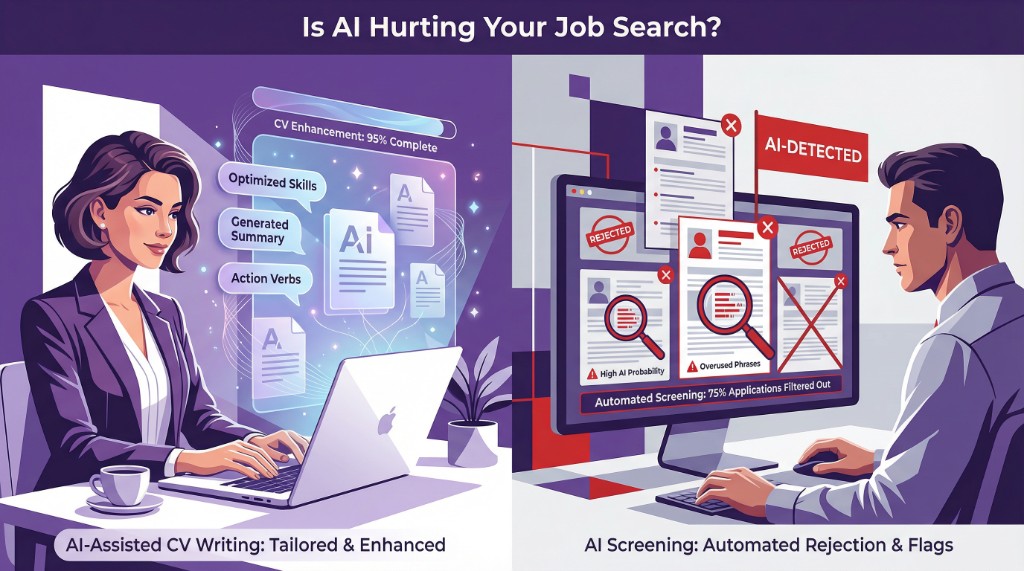
AI sits on both sides of hiring: helping candidates create better applications, but also screening and potentially rejecting them.
The Robot Trap
We have all seen the tells. Over-polished sentences, vague claims, inflated language, and buzzwords stacked on top of each other. Many recruiters and hiring managers report that generic, impersonal applications are a red flag, especially when they show little connection to the job.
This is not only a style problem. It is a trust problem. If your CV sounds generic, the reader has to wonder whether the achievements are real, whether you understood the role, and whether you will communicate clearly at work.
Research insight
A May 2025 survey of 600 U.S. hiring managers by TopResume found that 19.6% would reject a candidate with an AI-generated resume or cover letter, and 33.5% said they can spot an AI-generated resume in under 20 seconds.
What Recruiters Actually See
Hiring teams do not reject "AI" in the abstract. They reject patterns that look copy-pasted and low-effort. Common red flags include overly formal language, vague accomplishments with no proof, buzzwords without substance, and content that never references the real priorities in the job description.
Here is the difference in practice:
Generic AI output
"Leveraged cutting-edge methodologies to spearhead transformative initiatives, resulting in optimized operational efficiency across the organizational tapestry."
Human-edited version
"Led a cross-functional team to redesign our customer onboarding process, reducing time-to-value from 14 days to 3 days and improving customer satisfaction scores by 34%."
The second version wins because it is concrete. It shows scope, action, and measurable outcome in plain language.
Understanding AI's Real Strengths
The winning strategy is not to avoid AI. It is to use AI where it is strong, then apply human judgment where it matters most. Industry experts specifically describe AI as appropriate for summarizing, tightening phrasing, and tailoring to a role, as long as the content remains true and accurate.
Where AI genuinely helps
AI can help you move faster on the mechanical parts of a job application. That includes organizing structure, improving clarity, checking grammar, and identifying missing keywords or themes from the job description that you genuinely match. This aligns with how many employers describe acceptable AI use, such as proofreading or drafting support.
AI also helps in specific situations. Non-native speakers can use it to clean up grammar without changing substance. Career changers can use it to translate experience into role-relevant language. Senior professionals can use it to compress long careers into a focused, modern CV.
What AI cannot do
AI cannot verify your facts. It cannot know what you did, what constraints you faced, or what tradeoffs you made. It also cannot reliably judge what is most credible for a specific hiring context, which is why your final CV must be grounded in real evidence and written in a voice you can defend in an interview.
Your 3-Step Hybrid Workflow
This approach combines speed with credibility. It is built for the reality that some employers accept AI support while still expecting a personal touch and accurate claims.
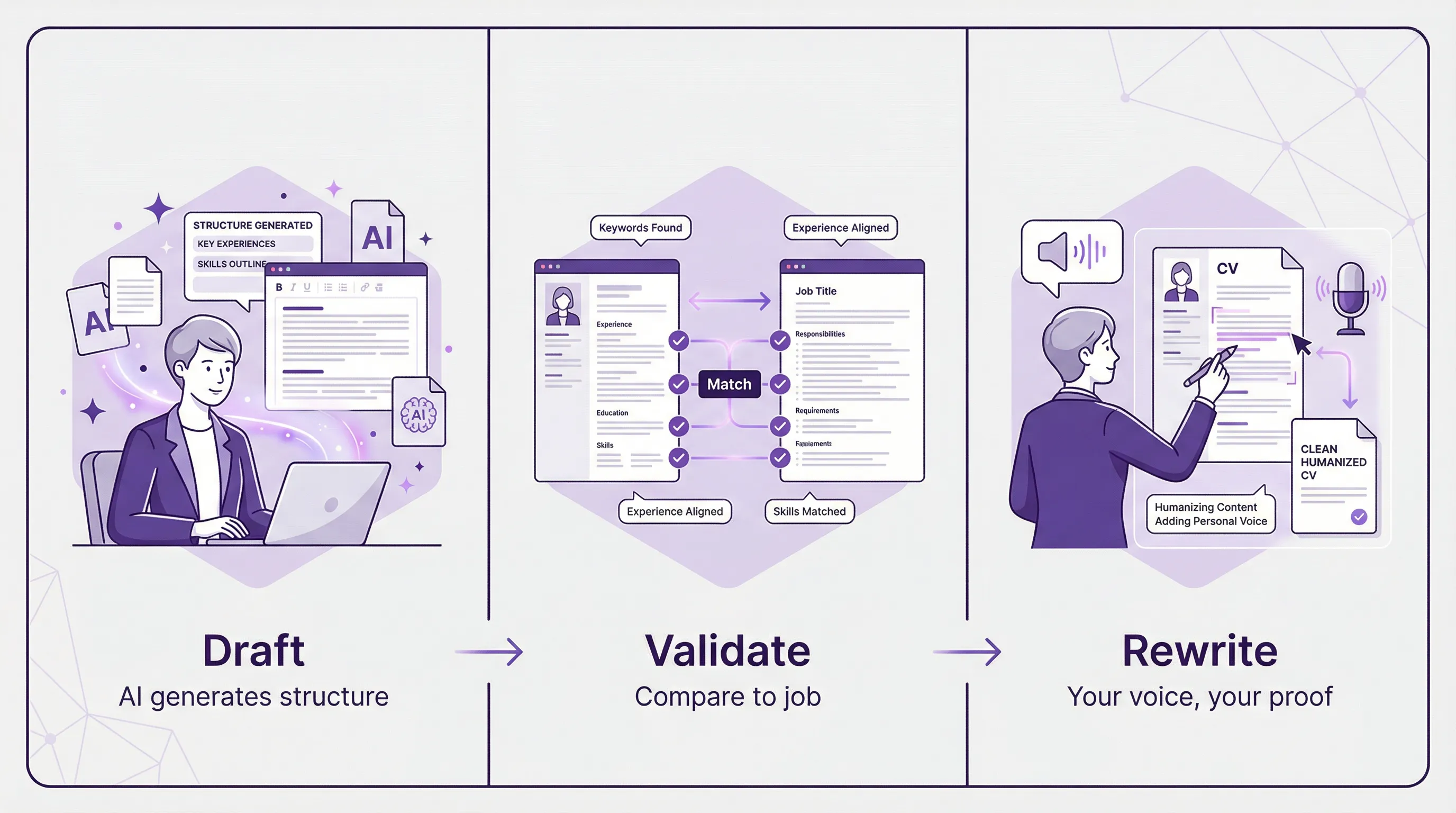
Draft, validate, then rewrite.
Step 1: Draft with AI Structure
Use our AI Assistant to generate a clean first draft of your summary and bullet points, then immediately anchor it in your facts. Add the details AI cannot invent responsibly: numbers, timeframes, tools, stakeholders, and outcomes you can explain.
Red flags that your draft is still too generic:
It could fit anyone.
Filler phrases instead of specifics.
No numbers or concrete nouns.
It reads like a template, not you.
Step 2: Validate Against the Job
"Feeling relevant" is unreliable. Validate your CV against the job description so you know what you are signaling. Use our Job Match tool to compare your drafted CV to the role requirements. The goal is not keyword stuffing. The goal is to confirm you are emphasizing the right experiences and using the vocabulary the employer uses, without harming readability. Quick wins are real qualifications you already have but did not highlight. True gaps are requirements you do not meet yet. Fix quick wins by re-ordering and tightening. Treat true gaps honestly by choosing a different role, adding a learning plan, or addressing the gap transparently if it is close.
Step 3: Rewrite in Your Voice
Many candidates lose points here. They keep the polished draft and forget that hiring is still a human trust exercise. Do the read-aloud test. If you would not say it in a first-round interview, rewrite it. Strip out vague adjectives and replace them with evidence.
Common Mistakes to Avoid
Mistake 1: Using AI Without Personalization
The biggest failure mode is not "using AI." It is using AI and sending the output without tailoring. Resume Now's 2025 report found that 62% of employers say AI-generated resumes without customization are more likely to be rejected, and 78% say personalized details signal genuine interest and fit.
Mistake 2: Not Fact-Checking AI
AI can produce confident errors. If you submit inflated numbers, incorrect dates, or responsibilities you did not own, you will fail reference checks or get exposed in interviews. Verify every claim. If you cannot prove it, do not publish it.
Mistake 3: Ignoring Industry Norms
Different industries expect different signals. A technical CV is not judged like a creative portfolio, and an academic CV is not judged like a product manager resume. Benchmark against real, successful examples in your domain.
Mistake 4: Over-Optimizing for ATS
ATS alignment matters, but readability still closes the deal. Employers explicitly say they want a human touch, and over-optimized keyword walls often look spammy. Use natural language that matches the job description where it is true.
Why This Hybrid Approach Wins
The job market rewards candidates who move fast and stay credible. The hybrid approach works because it keeps the efficiency of AI while protecting the two things hiring managers care about: truth and fit.
One more reality check: not every employer will react the same way. In the TopResume survey, 14.5% of hiring managers said AI should not be used by candidates at any stage, while many others accept limited AI support such as proofreading or drafting help. That is why your safest strategy is to use AI, but ensure the final output is accurate, personalized, and clearly written by a real professional.
Your Complete Toolbox
Ready to apply this workflow with less guesswork?
Draft
Use our AI Assistant to create a strong first version fast, then add your proof points: numbers, scope, tools, and outcomes.
Most employer-facing guidance treats AI as a tool. The line is crossed when AI introduces misleading claims or removes personalization. Surveys show many hiring managers accept limited AI support, especially for proofreading or drafting support, but still want the final product to feel human and tailored.
Can recruiters tell if I used AI tools?
Some say yes, at least when the content is generic. In the TopResume survey, 33.5% of hiring managers reported they can spot an AI-generated resume in under 20 seconds, which suggests low-effort AI output is a real risk.
What is the best way to use AI for my CV?
Use it to draft and improve clarity, then personalize and verify everything. Evidence matters more than elegance, and customization matters more than volume. Use purpose-built tools like our AI Assistant that are specifically designed for CV writing.
How long should my CV be?
One page is common for early career roles, two pages for many mid-career profiles, and sometimes longer for senior or academic contexts. The best rule is simple: every line must earn its place.
Should I mention that I used AI tools?
This is context-dependent. Some experts argue disclosure can help in roles where AI literacy is part of the job, while in many cases it is unnecessary and may distract from your qualifications. If you do disclose, keep it brief and emphasize that all content is true.
Keep Learning
This article covered the strategy. These guides go deeper on execution.