CV Diagnostics
Catch what is holding your CV back before a recruiter does. Structural checks and AI writing analysis in one panel.
Most candidates submit a CV they believe is ready. The gaps that cost them the interview are rarely obvious: a missing phone number, a summary in the wrong tense, a skill listed but never demonstrated anywhere in their experience, or achievement bullets that describe duties rather than outcomes. Diagnostics checks two things: whether the structure and content of your CV is complete enough to clear an ATS, and whether the writing itself is strong enough to hold a recruiter's attention. It runs these checks automatically and gives you a specific list of issues to work through, each with a proposed fix. You decide what to change.
Benefits
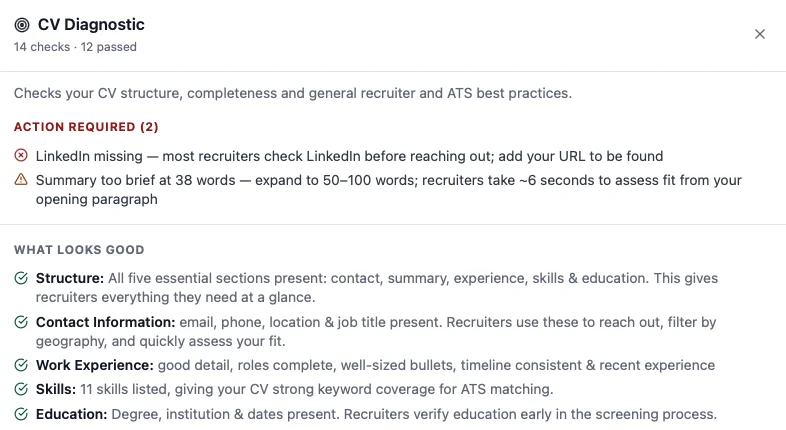
The structural check scans every section (contact details, summary, experience, education, and skills) and flags anything absent, too thin, or inconsistently filled in. A missing phone number or a job entry without dates is the kind of thing that causes an ATS to drop a CV silently.
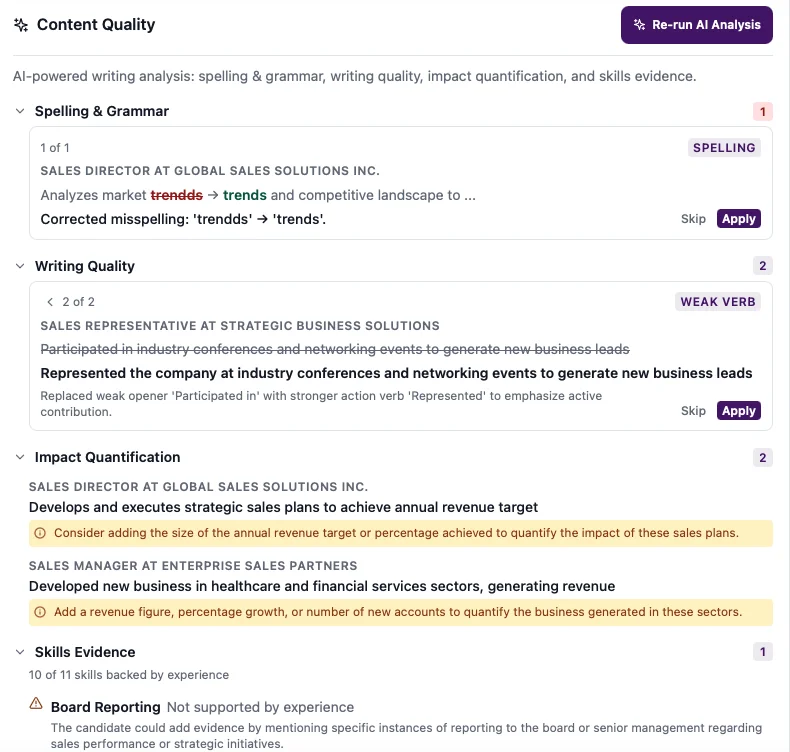
Weak verbs, passive voice, overused phrases, and sentences in the wrong tense are easy to miss in a document you have read too many times. The AI review picks these up and points you to the exact bullet or sentence, so you know what to fix rather than rereading the whole thing.
A bullet that describes what you did but not what resulted from it is harder for a recruiter to evaluate than one with a concrete outcome attached. The AI flags bullets with no measurable result and suggests where a figure, percentage, or specific outcome would make the point land.
A skill on your CV that does not appear anywhere in your work history is a risk in an interview. The skills evidence check reads your experience entries and tells you which skills are referenced and which are not.
Each suggestion targets a specific sentence, bullet, or field. You see the issue, why it was flagged, and a proposed fix. Nothing changes until you click Apply.
How it works
The structural check runs immediately and shows passed checks and issues grouped by section: contact information, professional summary, work experience, skills, and education. Issues are divided into two tabs: action required and what already looks good.
Each flag tells you what is missing or incomplete and which section to fix it in. Structural gaps are also the fastest wins. A missing phone number takes ten seconds to add, but without it a CV can fail the first filter before a recruiter ever reads it.
The AI reads your full CV and returns suggestions across four areas: spelling and grammar, writing quality (weak verbs, passive voice, tense, clichés), impact quantification, and skills evidence. Each suggestion shows the original text, the issue type, and a proposed fix.
The panel tracks your progress as you go. Once you have made changes, re-run the analysis to see what remains.
FAQs
Tips for best results
- Run the structural check before you start editing anything else. A missing phone number or an undated job entry is the kind of gap that causes a silent rejection before anyone reads the content, and it takes ten seconds to fix.
- Do not dismiss a suggestion just because the original phrasing sounds fine to you. The AI flags patterns that look acceptable in one bullet but read as a recurring weakness across a full CV. Check the flagged sentence in context before deciding.
- Use the skills evidence results as a writing prompt. If a skill shows as unsupported, look at your work history and ask whether you can add a sentence that demonstrates it. Adding context is more credible than removing the skill.
- Re-run the analysis after editing rather than applying every suggestion in one pass. Fixing one bullet can affect how the one next to it reads, and a second pass often catches things the first one missed.